

Tabla de contenidos
Master Technical Rope Rescue with Expert Training
For those ready to elevate their rescue skills, our technical rope rescue course delivers hands-on training in rope system construction, anchoring, ascending, descending, and litter operations. You’ll master river rescue techniques essential for swiftwater and vertical settings.
Designed for outdoor leaders, rescue personnel, and adventure enthusiasts, no previous experience is required. Our instructors bring 30+ years of expertise and hold swiftwater rescue training in Colombia and Wilderness First Aid certifications, ensuring every drill emphasizes safety with USCG-approved gear. Training takes place at our Cocorná base on real terrain.
Beyond the rope course, we also offer adventure tours in Colombia that let you experience the rivers and mountains firsthand. Contact us today to enroll in our technical rope rescue training, ask about course schedules, or plan your adventure.
1. Mechanical Advantage Systems for Efficient Lifts
Mechanical advantage (MA) is the ratio of output force to input force, and it’s the backbone of every efficient lift in technical rope rescue. Understanding MA lets rescuers move heavy loads with far less effort — a principle we apply daily in our operations.
A 1:1 direct pull gives no advantage but is fast to set up. The 3:1 Z-rig is often the most practical option for low-angle and high-angle lifts. According to the National Association for Search and Rescue (NASAR) guidelines, a basic Z-rig uses one movable pulley and one fixed pulley with a prusik backup. Adding a second 3:1 creates a 5:1 compound system for heavier loads. Always manage the rope edge to avoid abrasion — safety is non-negotiable.
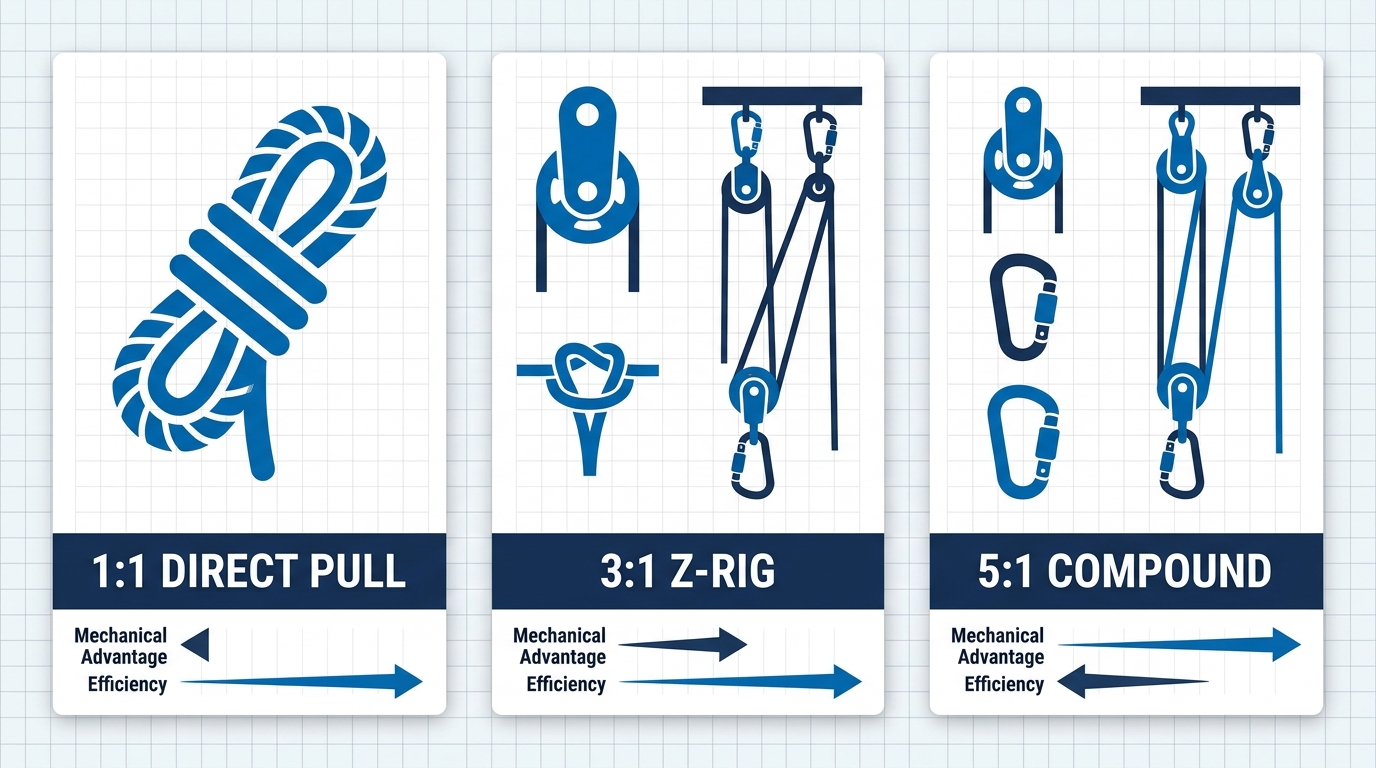 Comparison of mechanical advantage systems for rope rescue.
These river rescue techniques shine in swiftwater and canyon environments, exactly the kind of skill you learn in our swiftwater rescue training in Colombia. By the experts, our courses on the rivers of Antioquia teach you to build reliable systems under pressure. This is the foundation of safe, effective search and rescue training, and in the next section we’ll look at how to apply these systems in swiftwater environments.
2. Whitewater Rescue Applications for River Safety
Our commitment to safety goes beyond briefings—whitewater rescue applications are built into every expedition, significantly reducing risks and enhancing preparedness on the water.
During guided rafting trips in Colombia, our professionally trained guides—certified in Swiftwater Rescue and Wilderness First Aid—apply proven rescue techniques in real time. Throw-bag deployment allows quick retrieval of swimmers in fast currents, while boat-based rope systems create stable anchors for complex extractions on rivers like the Santo Domingo and Río Verde. Self-rescue techniques, developed By the experts and practiced regularly, ensure both guides and participants can respond when seconds matter. These are the same skills we teach in our river rescue and technical rope rescue courses, creating a direct link between learning and practical safety on every expedition.
With over 30 years of experience, our team’s rescue expertise makes every guided rafting in Colombia a safe, confidence-building adventure. For those wanting to master these skills, our dedicated rescue courses offer hands-on practice.
3. Essential Safety Gear for Canyon Rescues
Once you understand the rescue environment, the next critical factor is having the right gear. In any technical rope rescue, the equipment you carry determines whether an incident stays controlled or escalates. We start with certified, imported helmets — climbing- or whitewater-rated with secure chin straps — and rescue-specific harnesses with detachable leg loops for victim packaging. Our rope systems include static 11mm kernmantle ropes for lowering and hauling, plus dynamic ropes to absorb shock loads during vertical extractions — all chosen to match river rescue techniques used in steep canyons. Haul systems rely on progress capture pulleys and Prusik cords, and every locking carabiner we use is rated above 27 kN. For water rescues, our USCG-approved Type V PFDs feature quick-release buckles and knife tabs — the same type used in swiftwater rescue training in Colombia courses. Mandatory extras include a serrated rescue knife, a whistle, a waterproof radio, webbing anchors, and a compact trauma kit. We maintain all gear to manufacturer specifications, relying on certified equipment imported for your safety.
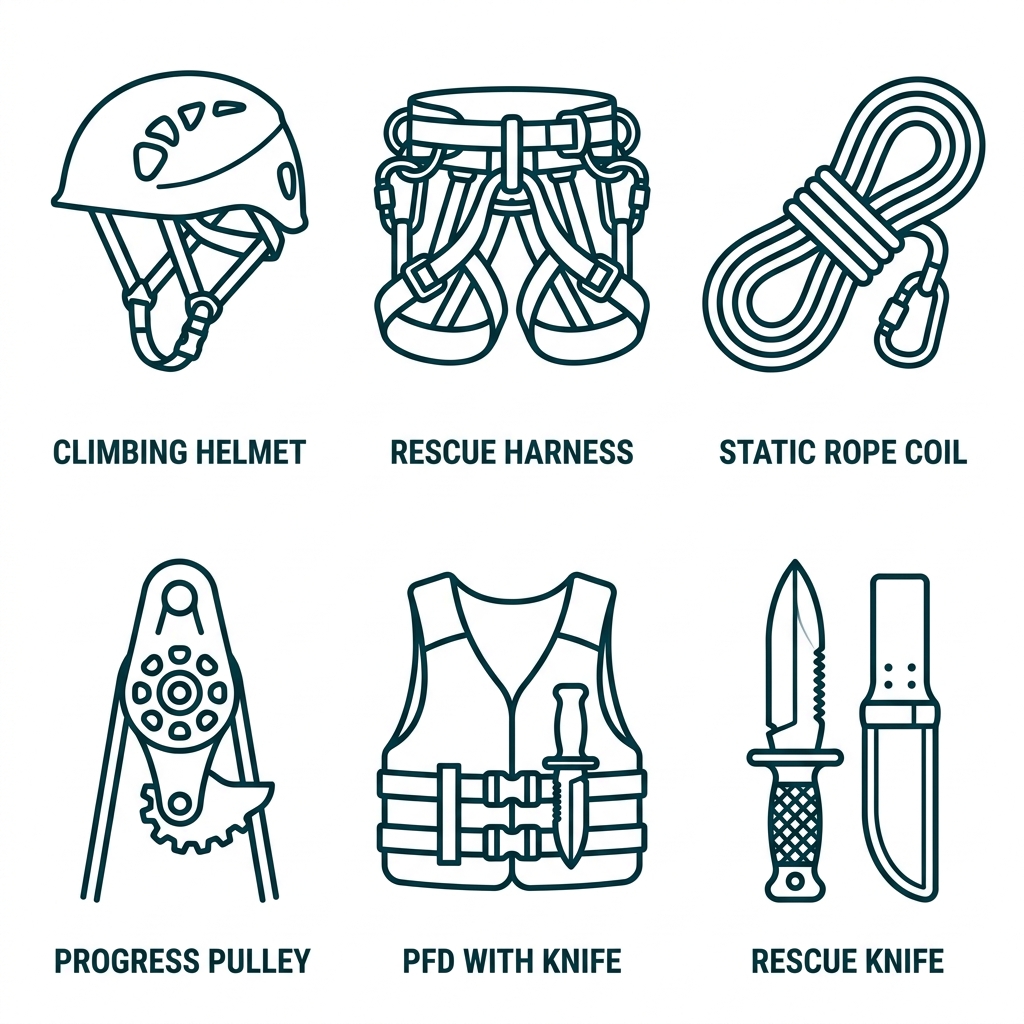 Essential safety gear for canyon rescues in a clean icon grid
All of this gear is put to work in our hands-on technical rope rescue courses, and it’s a big part of what makes an eco adventure in Colombia with Freak’n Creek’n safe and unforgettable.
Victim Stabilization
Once the rescue scene is assessed and secured, our priority in a technical rope rescue is victim stabilization. We focus on preventing further injury while preparing for a safe, controlled descent. Following NASAR protocols, we use a structured approach that protects both the victim and rescuers.
- Assessment: We perform a primary survey (ABCDEs) specific to the suspended victim, checking for suspension trauma and life-threatening conditions. A secondary assessment then identifies additional injuries without compromising spinal alignment.
- Packaging: We apply spinal motion restriction with a cervical collar and secure the victim into a SKED or Stokes basket. This packaging adds protection and facilitates a controlled slide.
- Lowering: We rig a mechanical advantage — often a 3:1 or 5:1 Z-rig — to gently lower the packaged victim. During this phase, we add insulation layers and a rescue blanket inside the litter to prevent hypothermia.
We teach these victim stabilization protocols in our technical rope rescue courses in Colombia. By the experts, our guides integrate common river rescue techniques to enhance safety. These skills are a core part of our swiftwater rescue training in Colombia, and they support responsible tourism in Colombia by prioritizing environmental stewardship. With the victim stabilized and packaged, the team proceeds to the lowering or raising phase.
5. Technical Rope Rescue vs Mountain Rescue
Technical rope rescue is a discipline for steep terrain near water — think canyons, cliffs, and waterfalls — where rope systems extract rafters, kayakers, and canyoners. Mountain rescue, on the other hand, addresses alpine, snow, and high-angle rock environments: glaciers, ice, and high-altitude search and rescue. Both share core rope skills such as anchors, mechanical advantage, and lowering/lifting, but the context is what sets them apart. The National Association for Search and Rescue (NASAR) sets the benchmark for both, and our training aligns with those standards.
While mountain rescue demands ice screws and cold-weather survival gear, our technical rope rescue course focuses on dynamic ropes, pulleys, and water-resistant equipment — the exact tools you need when every second counts on a river.
At Freak’n Creek’n, we offer technical rope rescue training that blends river rescue techniques with hands-on practice. Our rope rescue course is built for paddlers, raft guides, and canyon explorers who need swift, safe extraction in wet, rugged terrain. Because we’ve spent over 30 years on Colombian rivers, our swiftwater rescue training in Colombia is designed around real scenarios. If your adventures center on water, this is the course for you.
6. Reliable Anchor Systems in River Canyons
In any technical rope rescue scenario, a reliable anchor system is the foundation of safety. An anchor connects the rescue load to a secure point, ensuring river rescue techniques can be executed without failure.
In river canyons, we rely on two anchor categories:
- Natural anchors: sturdy trees, large boulders, and rock horns
- Artificial anchors: pitons, bolt kits, and hardware placed into canyon walls
Every system must incorporate redundancy y equalization. Redundancy uses multiple anchor points so a single failure does not cause collapse. Equalization distributes the load evenly, preventing excessive force on any one point.
With over 30 years of experience, Freak’n Creek’n’s guides are trained to evaluate and construct reliable anchors in real canyon conditions. Our technical rope rescue courses teach hands-on assessment, selection, and application of these principles. You’ll learn anchor systems set up by the experts, supported by our background in swiftwater rescue training in Colombia.
Adventure activities carry inherent risks; participants must follow guide instructions and safety briefings. Next, we’ll cover knot systems and rope management that complete the rescue setup.
Entrenamiento en Rescate en Aguas Rápidas
Beyond paddling skills, our swiftwater rescue training in Colombia equips you with critical techniques for safety on the river. Our courses, held on the Río Santo Domingo and Río Verde in Cocorná, Antioquia, integrate technical rope rescue with hands-on scenarios.
Led by guides certified in Swiftwater Rescue and Wilderness First Aid, our curriculum follows NASAR guidelines, ensuring a systematic approach to river rescue techniques. We train everyone from beginners to seasoned professionals, and because we use actual rivers instead of simulated pools, you gain practical experience that mirrors real emergencies. This swiftwater rescue training in Colombia is designed for those who want to lead or respond in demanding environments. By the experts, you’ll learn how to read currents, manage hazards, and perform advanced rescues with confidence.
These rescue skills form the backbone of safe adventures; invest in your safety and revive yourself in nature’s classroom.
Mastering Essential River Rescue Techniques
Mastering technical rope rescue is essential for any whitewater enthusiast planning to navigate Class III+ rapids. The powerful currents you experience on rivers like the Río Calderas, with its technical II–IV sections, or the demanding Class III–IV+ jungle expedition on the Río Samaná demand more than just solid paddling skills. Understanding the risks is the first step; mastering the full range of river rescue techniques is the critical next one to ensure every trip is as safe as it is exhilarating.
Nuestro swiftwater rescue training in Colombia at Freak’n Creek’n is designed to build these exact skills. This comprehensive course covers vital techniques from self-rescue and aggressive swiftwater swimming to precise throw bag deployment and building mechanical advantage systems for technical rope rescue. As the only provider in Antioquia offering certified technical rope rescue courses, our program is led by a team of professional guides who all hold Swiftwater Rescue and Wilderness First Aid certifications, ensuring you receive top-tier, internationally-aligned instruction.
When you’re ready to move beyond basic river running and truly take control of your safety in whitewater environments, it’s time to act. Dive into our professional training programs and learn to lead with confidence. Contact us today to sign up for a rescue course or to request a schedule for our upcoming river rescue clinics.
Advance Your Rescue Skills with Freak’n Creek’n
Beyond our daily adventures, we also specialize in advancing your rescue skills with focused courses for outdoor enthusiasts and professionals. Our technical rope rescue programs, along with swiftwater rescue training in Colombia, provide hands-on instruction for high-angle and fast-water scenarios. With over 30 years of experience, our professionally trained guides share real-world river rescue techniques that build competence and confidence. Every course uses USCG-approved life jackets and certified equipment, reinforcing our commitment to safety and responsible tourism through our ACOTUR certification. Join us at our Cocorná basecamp to upgrade your rescue capabilities and take the next step toward professional-level preparedness for river professionals and serious enthusiasts.