

Table of Contents
- Essential Swiftwater Rescue Gear for Professional Rescuers in Colombia
- Understanding Swiftwater Rescue Gear Components and Standards
- Benefits of High-Quality Swiftwater Rescue Gear in Colombia
- Mastering the Z-Drag Rescue System: Setup, Mechanics, and Safety
- Best Practices for Swiftwater Rescue Gear Inspection and Maintenance
- Build Your Swiftwater Rescue Gear Kit with Confidence
Essential Swiftwater Rescue Gear for Professional Rescuers in Colombia
When it comes to swiftwater rescue gear, having the right equipment is just as critical as mastering technique. In Colombia’s warm waters, steep gradients, and tropical environment, your gear must perform reliably under demanding conditions. We know that every rescuer’s safety depends on both their training and their tools.
Professional rescuers operating in Colombia should assemble a personal kit that covers self-rescue and team-response scenarios. Core swiftwater rescue gear includes:
- Personal flotation device (PFD): Choose a Type V PFD that is USCG-approved and designed specifically for swiftwater use, with a quick-release harness and ample flotation for turbulent water.
- Helmet: A water-sports helmet meeting CE or ASTM standards protects against head impacts from submerged rocks and debris.
- Throw bag: A 70- to 75-foot bag with floating polypropylene line is essential for reaching swimmers quickly.
- Rescue knife: A blunt-tip, fixed-blade knife mounted on your PFD provides immediate cutting capability for entangled lines.
- Whistle: A pealess whistle attached to your PFD signals teammates across roaring river noise.
- Carabiners and webbing: Locking carabiners and tubular nylon webbing form the backbone of mechanical-advantage systems like a Z-drag rescue.
- Dry bag: Keeps communication devices and medical supplies protected in Colombia’s rain-prone environment.
For those enrolling in a water and ice rescue training course, a complete gear kit is a prerequisite. Lifesaving.com, a respected industry source, emphasizes that all rescue equipment should meet or exceed NFPA 1670 and NFPA 1006 safety standards. When you take a river rescue technician course, you’ll learn to use carabiners, pulleys, and webbing to rig Z-drag rescue systems — gear that must be inspected before every session.
By the experts, we remind every rescuer that equipment alone does not guarantee safety. Adventure activities carry inherent risks, so always follow your guide’s instructions and safety briefings. With the right swiftwater rescue gear, Colombia’s professional rescuers can respond effectively and protect their teams on demanding rivers.
Understanding Swiftwater Rescue Gear Components and Standards
When we discuss swiftwater rescue gear, we are talking about the specialized equipment that forms the backbone of every safe river expedition. Drawing on our 30+ years of experience, our professionally trained guides rely on certified, imported equipment to manage the dynamic challenges of whitewater environments. Our team holds Swiftwater Rescue and Wilderness First Aid certifications, so we understand firsthand how critical it is to have the right gear on the water. This section breaks down the essential components and the standards that make them trustworthy.
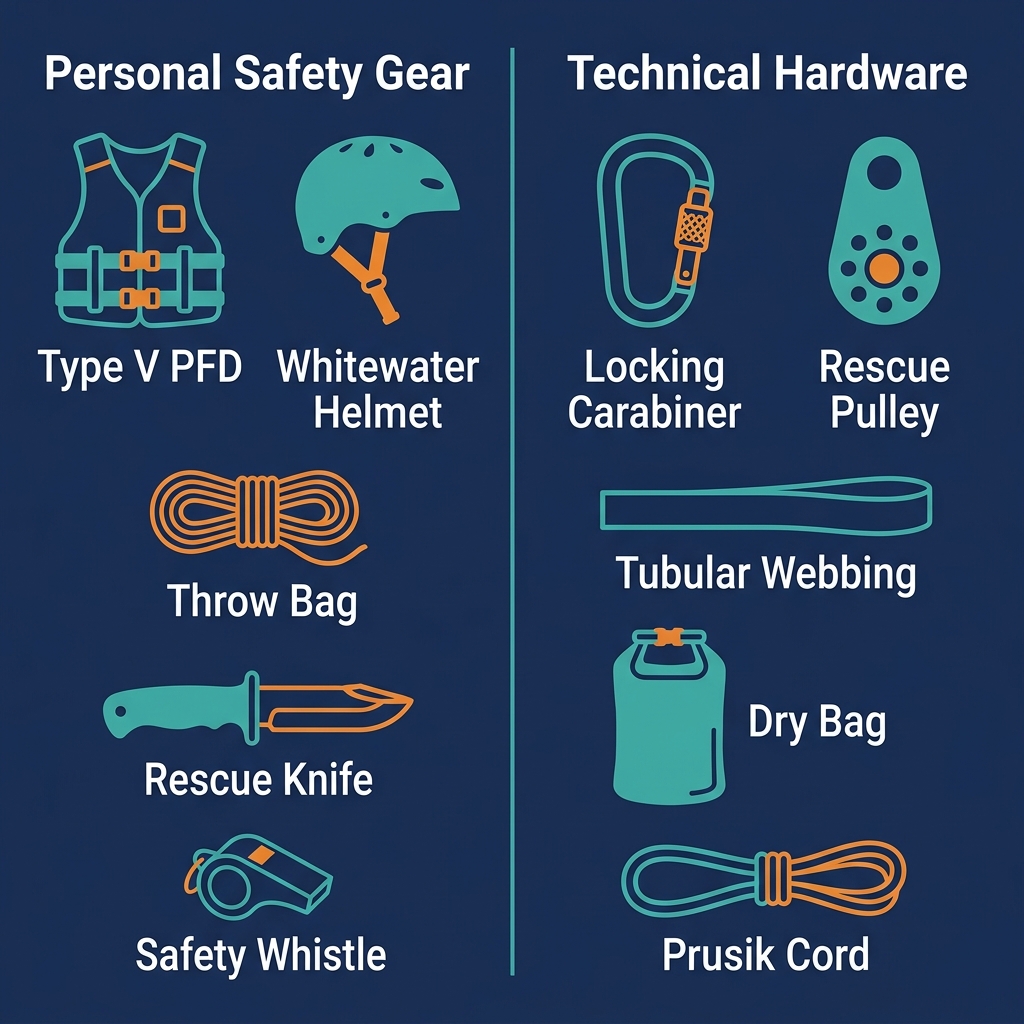 Essential swiftwater rescue gear categorized by safety and hardware components.
Personal Flotation Devices and Helmets: Your First Line of Defense
In swiftwater environments, a USCG-approved personal flotation device is non-negotiable. These life jackets are designed to keep an unconscious wearer face-up in turbulent water, meeting rigorous buoyancy and fit standards that recreational vests simply do not. We pair them with whitewater helmets that protect against impact from rocks and hydraulics. Helmets like the WRSI models we use feature crush-rated shells and secure retention systems, specifically engineered for the repeated submersion and blunt force common in river rescue. Regular inspection of buckles, straps, and foam is essential — a compromised piece of personal safety gear cannot do its job. Choosing certified, imported equipment means you are trusting gear that has been tested to international benchmarks, not local approximations.
Technical Rescue Hardware: Carabiners, Pulleys, and Throw Bags
Beyond personal protection, river rescue demands reliable technical hardware. A basic swiftwater kit includes:
- Locking carabiners rated for multi-directional loads
- Prusik-minding pulleys that handle muddy ropes without jamming
- Throw bags with buoyant, high-visibility line
- Webbing and anchors for constructing a Z-drag system
The Z-drag rescue technique multiplies hauling force, allowing a small team to pull a pinned boat or swimmer free. Certified equipment suppliers like Trident Rescue provide pulleys and carabiners that meet exacting performance standards, reducing the risk of mechanical failure under extreme loads. We inspect every piece of hardware before each trip, checking for corrosion, gate function, and rope wear. This discipline comes not just from manufacturer guidelines but from the practical wisdom gained in river rescue technician courses, where our guides learn to trust their gear implicitly.
Building a Multi-Day Expedition Rescue Kit
For multi-day expeditions, a basic day-trip kit must expand to cover self-sufficiency. Spare carabiners, replacement webbing, and a second throw bag become mandatory when you are days from a resupply point. Communication devices — a charged satellite phone or a VHF radio — are as vital as any piece of hardware. A properly stocked first-aid module goes beyond bandages; it includes splinting materials, wound irrigation supplies, and medications suited to tropical environments. For longer journeys, supplement your rescue kit with standard whitewater kayaking equipment like spare paddles, dry bags, and repair kits for inflatables. Every item must be inspected before departure, and we recommend that at least one team member have formal training through a river rescue technician course to coordinate its use effectively. A well-planned kit empowers you to explore yourself with nature without compromising safety.
We design every rafting trip and expedition to create great adventure, food, fun and memories, and that begins with the gear that keeps everyone safe. All adventure activities carry inherent risks; participants must follow guide instructions and safety briefings. With the right swiftwater gear in your boat, you are ready to focus on the skills and techniques that turn a river trip into an unforgettable journey.
Benefits of High-Quality Swiftwater Rescue Gear in Colombia
High-quality swiftwater rescue gear isn’t an accessory—it’s a lifeline on Colombian rivers. At Freak’n Creek’n, we rely on USCG-approved life jackets, WRSI helmets and certified technical ropes, and we know the right equipment makes all the difference. Here’s why investing in professional swiftwater rescue gear matters.
Enhanced Safety and Survival in High-Impact Environments
In swiftwater environments, certified gear must hold up against punishing currents and sharp debris. USCG-approved PFDs deliver buoyancy that stays secure in violent water, while WRSI helmets protect against impacts on rocks and logs. Certified throw bags float reliably, deploy fast and provide secure attachment points for mechanical advantage systems including the Z-drag rescue. Secure attachment points can be the difference between a controlled rescue and a catastrophic failure. This equipment dramatically reduces the risk of equipment failure for rescue technicians and the people they’re helping. While no product can promise absolute safety, our USCG-approved swiftwater rescue gear gives our team—and those we assist—the best possible outcome in a high-stakes situation. Our decades of experience have shown us that quality gear is non-negotiable for effective river rescue. Our guides trust that the gear won’t fail, letting them focus entirely on the rescue.
Compliance with International Training Standards
Professional river rescue technicians in Colombia follow standards from the American Canoe Association (ACA) and Rescue 3 International. Their courses—including the river rescue technician course—require USCG-approved PFDs, helmets and throw ropes, and they teach systems like the Z-drag rescue from day one. This requirement exists because skills alone aren’t enough; gear must perform under pressure. For anyone pursuing these credentials, the river rescue certification price is a smart investment that opens doors to guiding and rescue jobs worldwide. Our own trainings integrate the same standards, and we encourage participants to budget for certification as part of their professional development. Completing an ACA or R3 course with certified swiftwater rescue gear earns a globally recognized credential that can lead to opportunities from Colombia’s rivers to swiftwater rescue teams abroad. That certification sets you apart in a competitive field and proves your commitment to safety.
Sourcing Specialized Gear in South America
Finding USCG-approved swiftwater rescue gear locally in Colombia is tough. Most outdoor shops stock basic paddling accessories, not certified pulleys, static ropes or throw bags rated for a Z-drag rescue. For technical equipment, importing directly from U.S. distributors is often the most reliable route. We’ve built our inventory of custom rafts, WRSI helmets and rescue hardware this way, and we share our sourcing channels with trainees. Here are practical first steps:
- Research U.S. brands that meet USCG or NFPA standards
- Contact suppliers directly to arrange international shipping
- Partner with a local operator who can pool orders
- Ask training providers for recommended distributors
Our guests tell us that knowing we use imported, certified gear gives them confidence. When you’re learning a Z-drag rescue or swiftwater entries, training with the same equipment that river professionals trust worldwide makes a real difference. And once you have your own set of USCG-approved swiftwater rescue gear, you’re always ready for the next certification or job.
Mastering the Z-Drag Rescue System: Setup, Mechanics, and Safety
When swiftwater rescuers need mechanical advantage, the Z-drag rescue system is our go-to. Signing up for a technical rope rescue course teaches you the 3:1 Z-drag setup that makes extractions safer. Let’s break down the setup, essential gear, common mistakes, and the formulas that make it work.
Setting Up a 3:1 Z-Drag System
Here’s the sequence we teach in our courses:
- Anchor securely using webbing or sling.
- Attach a high-efficiency pulley to the main line and clip it to the anchor carabiner.
- Run the rope toward the load, placing a second pulley at the load.
- Route the rope back to the first pulley, creating the “Z” shape.
- Tension slowly with a Prusik or belay device and verify all connections.
The Z configuration multiplies your pulling force threefold, reducing the effort needed to move a pinned raft or kayak. Training under expert guidance reinforces these steps so they become automatic.
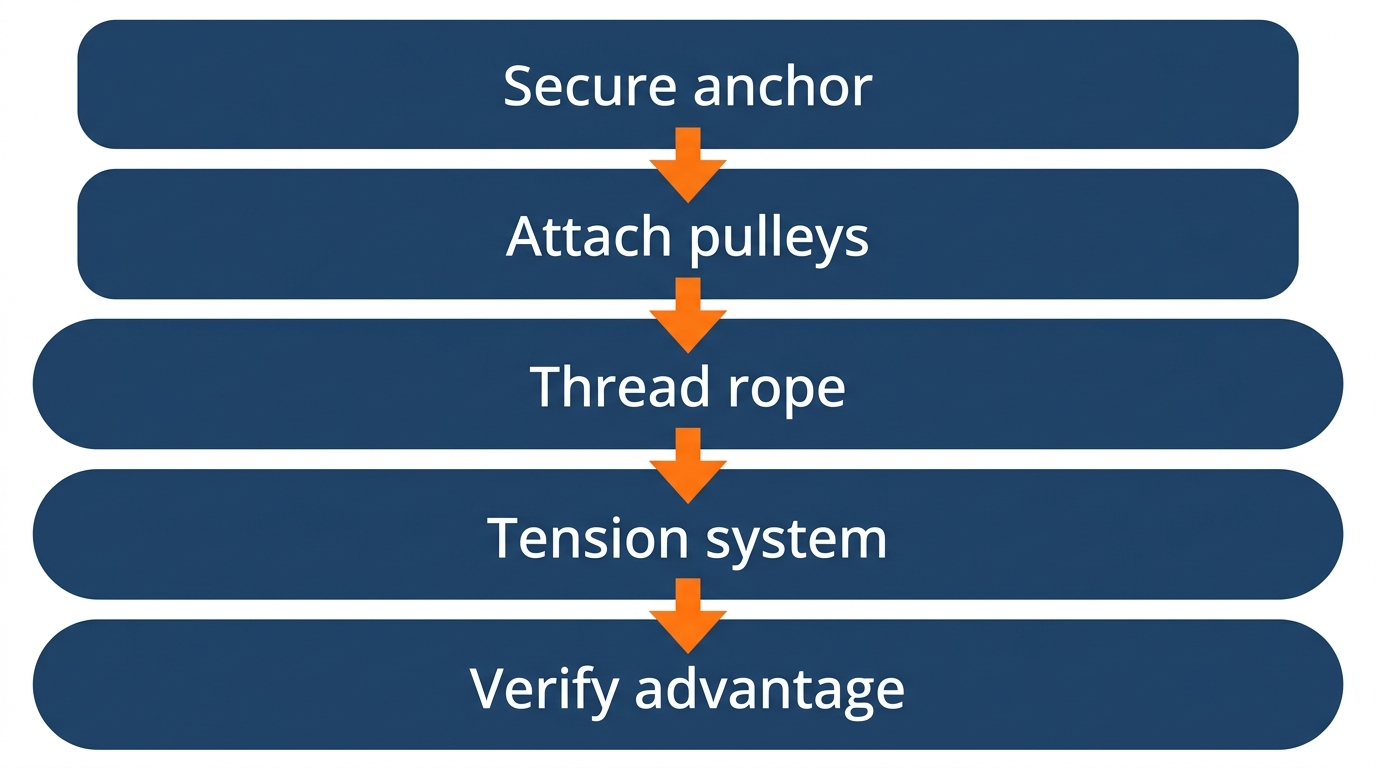 Five-step Z-drag rescue setup from secure anchor to mechanical verification
Once built, your Z-drag rescue system delivers impressive pulling power; now let’s talk about the gear that makes it reliable.
Key Components of a River Z-Drag Rescue Kit
- Static rescue rope (low stretch)
- Two high-efficiency pulleys
- Locking carabiners
- Tubular webbing or slings
- Prusik loops
- Anchor system (natural, camming, or portable plates)
Every piece in your swiftwater rescue gear bag must withstand dynamic loads and immersion. Industry suppliers like Colorado Kayak stock high-quality pulleys, Prusik cords, and locking carabiners that meet the demands of whitewater environments. We inspect our gear before every trip and recommend you do the same. With the right gear and careful setup, you avoid the typical hiccups that catch even experienced paddlers.
Now, let’s look at the most common pitfalls and how to dodge them.
Common Mistakes and How to Avoid Them
Improper anchor placement leads most mistakes: an anchor that shifts under load can compromise the whole system. Always verify your anchor is solid and aligned with the pull. Tangled rope creates dangerous snags; flake your rescue line carefully and keep it free of sharp edges. Another critical error is releasing tension without a belay; always use a Prusik knot to capture progress and lower loads in a controlled manner. Misjudging load weight can lead to system failure; always reassess the force required before you pull. Dry-land practice ingrains these habits for real swiftwater scenarios.
Calculating Mechanical Advantage for River Rescues
Mechanical advantage (MA) is the ratio of load force to pull force. In a 3:1 Z-drag system, pulling one foot of rope moves the load only four inches, tripling your strength—though real-world friction often reduces that to about 2:1. To select the right setup, gauge the load: a pinned raft may need hundreds of pounds of force. For heavier loads, move to a 5:1 piggyback or complex system. The best choice matches the rescue scenario, the gear you carry, and how many rescuers are pulling. Our rescue courses let you practice these systems hands-on, building confidence for real emergencies.
Best Practices for Swiftwater Rescue Gear Inspection and Maintenance
Having the right gear is just the start — regular inspection and proper care keep it reliable in Colombia’s swiftwater environments.
Regular Inspection Protocols for Your Rescue Gear
We recommend establishing a consistent inspection routine for swiftwater rescue gear to catch wear before it becomes a hazard. Visual and tactile checks reveal hidden damage that can compromise performance. A simple, repeated schedule keeps your equipment field-ready.
- Life Jackets: Check for tears, fading, and buckle integrity after each outing.
- Helmets: Inspect shells and straps for cracks, dents, or fraying weekly.
- Ropes: Examine for abrasions, soft spots, and dirt build-up every trip.
- Hardware: Verify that carabiners, pulleys, and descenders lock smoothly and show no corrosion monthly.
In Cocorná’s humid lowlands, we pay extra attention to mold growth and UV degradation. Sunlight and moisture accelerate wear, so we suggest pairing routine inspections with immediate post-run cleaning. By making these checks second nature, you prolong the life of every piece and maintain the safety standards our team relies on.
Maintenance Tips to Prolong Gear Life
Proper storage and cleaning dramatically extend a piece’s useful life. After each trip, rinse life jackets, helmets, ropes, and hardware with fresh water to remove silt, chemicals, and organic matter. Dry everything out of direct sunlight — ultraviolet rays weaken nylon and plastic components. Store gear in a cool, ventilated area, never in a sealed bag, to prevent mildew.
We also avoid stacking heavy items on helmets or life jackets, which can distort their shape and reduce protective performance. When swiftwater rescue gear is cared for this way, it remains compliant with international safety standards and performs reliably through multiple seasons. In Antioquia’s rainforest climate, where humidity is a constant factor, these simple habits make the difference between gear that lasts and gear that fails when you need it most.
Preparing for a River Rescue Technician Course
Before you attend a river rescue technician course, gather the right rescue equipment. You’ll need a rescue personal flotation device, a reliable throw bag with floating rope, locking carabiners, pulleys, prusik loops, and a helmet. Having your own kit lets you train with the gear you’ll use in the field.
Our programs at Freak’n Creek’n integrate hands-on inspection directly into the curriculum. From day one, you practice pre-use checks and learn how small oversights in rope or hardware conditions can derail a Z-drag rescue. This mechanical system depends on well-maintained components to create the leverage needed for swift, safe extractions. Mastering it under real conditions in Colombian rivers builds confidence and muscle memory.
Completing the course prepares you for swiftwater rescue certification that validates your competency and opens doors to professional guiding and rescue team roles. Once your gear is inspection-ready and you’ve completed the technician course, the next step is to explore advanced rescue techniques that build on these fundamentals.
Build Your Swiftwater Rescue Gear Kit with Confidence
After you’ve completed a river rescue technician course, assembling the right swiftwater rescue gear kit is the next essential step. We know from our 30+ years on Colombian rivers that gear selection directly impacts safety. The University of Missouri’s river rescue curriculum reinforces this, highlighting that well-chosen equipment is just as critical as rescue technique. Applying principles from University of Missouri programs helps you build a kit you can trust.
A solid kit starts with a few core components:
- USCG-approved PFD
- throw bag
- pulleys
- carabiners
- webbing
- rescue rope
These pieces form the foundation of any Z-drag rescue system and countless other river scenarios.
But confidence in your kit goes beyond the gear list. It comes from reliability—choosing items with USCG-approval or CE marks and maintaining them properly. For the mechanical-advantage demands of a Z-drag rescue, select pulleys and prusik cords that will not slip under load, and build anchor systems from strong, static webbing. In the steep, technical rivers around Cocorná and across Antioquia, we recommend gear that can handle repeated strain without compromising performance. We focus on value: investing in high-quality swiftwater rescue gear that performs under real conditions—like the throw bags and carabiners we source from Minam Store—ensures you spend wisely and paddle safely. With your kit fully assembled, you’ll step onto the river with informed confidence. Next, we’ll explore how to keep your gear in top shape for the season ahead.