
Table of Contents
River Rescue Techniques Fundamentals
River rescue techniques are the industry-standard methods that whitewater rafting guides, kayakers, and outdoor professionals rely on to respond effectively during swiftwater emergencies on technical rivers. In our courses, you’ll master three core skill areas: throw bag deployment for reaching a swimmer quickly, controlled defensive and aggressive swimming rescues, and technical rope rescue systems like the Z-drag that use mechanical advantage for extraction. Our swiftwater rescue training in Colombia begins with flat-water drills to build muscle memory, then progresses to real swiftwater scenarios on Antioquia’s steep, fast-flowing rivers. Colombia’s rivers are known for their steep gradients and powerful flows, making these fundamental skills especially critical. By practicing these proven methods repeatedly, you’ll develop the confidence to act quickly under pressure. They form the backbone of every rescue scenario we teach, and you’ll practice these fundamentals in depth at our river rescue school in Colombia.
1. Master Foot Entrapment Releases
Foot entrapments are among the most critical river rescue techniques to understand, especially for whitewater paddlers. When a swimmer’s foot wedges between submerged rocks, the current pins the body downstream, making self-release extremely difficult. Without proper training, the outcome can be fatal.
To escape, we teach a three-step release: relax the trapped foot and leg, roll onto your back facing upstream so the current lifts the foot, then push off with your free foot and swim downstream. As one of the essential river rescue techniques, this maneuver builds confidence and demands supervised practice.
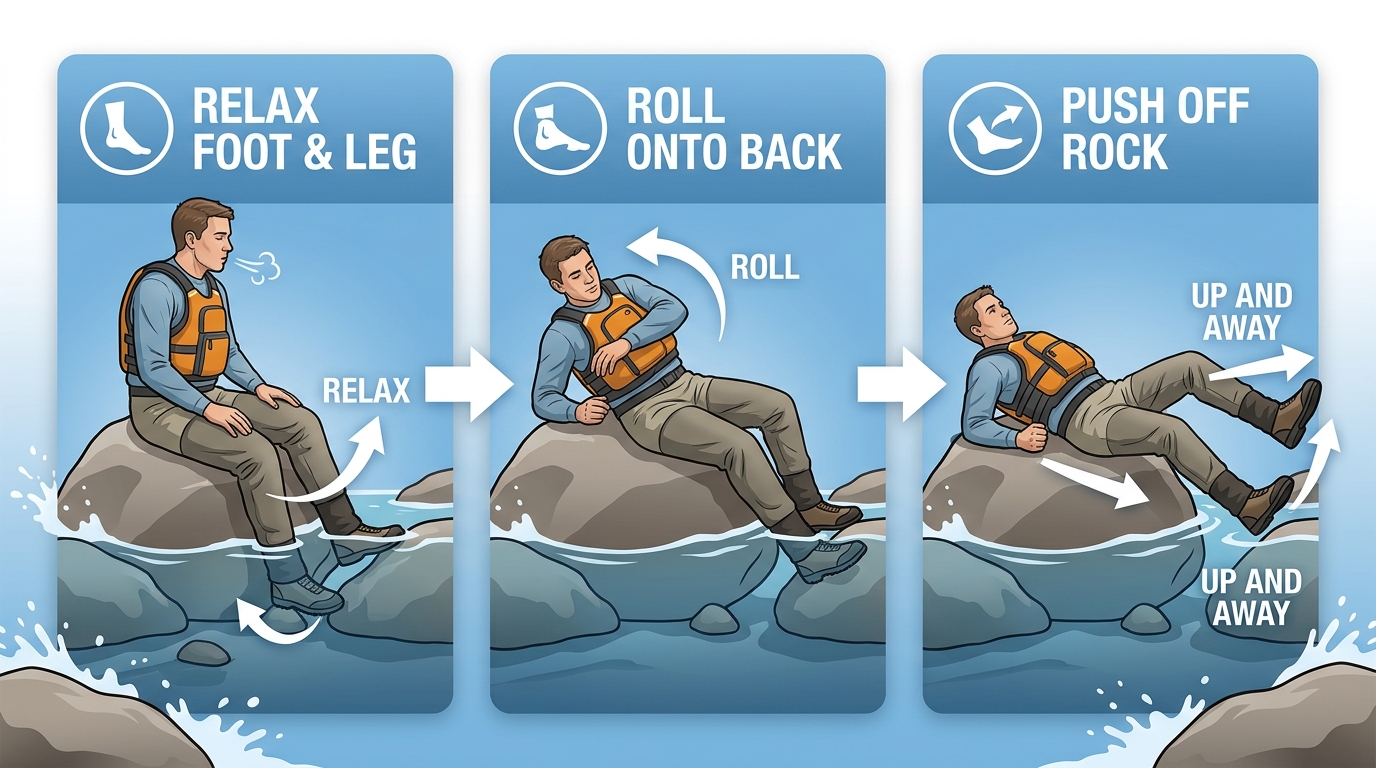 Foot entrapment release process flow diagram for swiftwater rescue training
For swiftwater rescue training in Colombia, our Swiftwater Rescue Certification course provides hands-on practice of foot entrapment releases in controlled river settings. Should a simple release fail, our guides deploy technical rope rescue systems for safe extraction. Reinforced in our River Rescue School, these skills let you revive yourself in nature with confidence. Mastering this release is the first step toward advanced rescue proficiency.
2. Perfect Defensive Swimming
Among essential river rescue techniques, defensive swimming is the first self-rescue skill we teach at Freak’n Creek’n.
- Float on your back with your feet pointing downstream and hips up.
- Keep your knees slightly bent and your feet just above the surface to absorb shock if you strike rocks.
- Scull your arms gently by your sides to stay stable without fighting the current.
As you float, use your arms to rotate and sweep, only kick if you need to avoid a hazard or steer toward an eddy. One of the biggest mistakes is trying to swim face-down or stand in fast-moving water; always keep your feet downstream and never attempt to stand until you reach calm, shallow water.
American Whitewater Association guidelines reinforce this position, and in our swiftwater rescue training in Colombia (held on Cocorná’s Río Verde and Río Calderas) we practice defensive swimming so you’re ready for real rapids. Once you master defensive swimming, technical rope rescue systems can assist with extraction in more complex scenarios.
Because at Freak’n Creek’n, every rescue skill adds to the great adventure, food, fun and memories you’ll take home.
3. Know Raft vs. Kayak Rescues
Understanding river rescue techniques is essential for whitewater paddlers, but the methods vary greatly between rafts and kayaks. Raft rescues involve team coordination and heavy gear, while kayak rescues emphasize individual self-recovery.
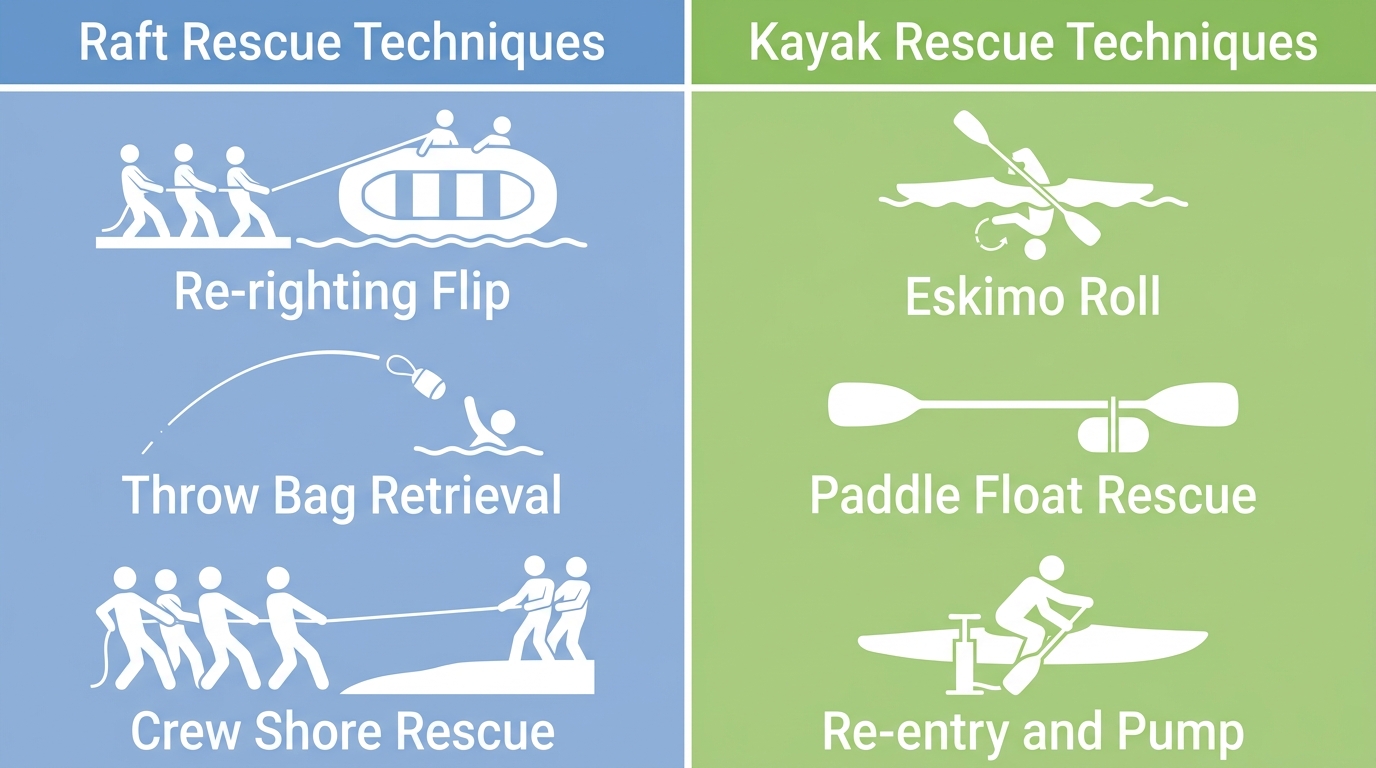 Visual comparison of raft and kayak rescue techniques: coordinated team maneuvers vs individual self-recovery skills.
Raft rescues require a crew and techniques like re-righting a flipped raft using a flip line or T-rescue, or performing a line rescue from shore. Kayak rescues rely more on self-rescue skills such as the Eskimo roll and paddle float rescue, with re-entry and pump assisted by a single rescuer. Equipment differs: rafts use throw bags, handlines, and flip lines, while kayaks need pumps, spare paddles, and float bags. Raft rescues emphasize managing group safety and pulling the craft to shore, whereas kayak rescue focuses on rapid individual recovery to prevent entrapment. Both craft benefit from technical rope rescue systems when complex scenarios arise.
Mastering both rescue types is key to safe river operations, and our swiftwater rescue training in Colombia covers each craft’s unique demands. For those seeking formal instruction in kayak rescue, our dedicated kayak instructor training in Colombia covers these maneuvers in depth.
4. Tackle Tropical River Hazards
Beyond standard river currents, tropical waterways pose unique challenges that demand specialized river rescue techniques. In warm, jungle-fed rivers, you might face sudden flash floods triggered by upstream rain, submerged logs that act as deadly strainers, intense eddy lines that can disorient even strong swimmers, and venomous snakes or biting insects drawn to the water.
Proper preparation includes reading water levels to anticipate flash floods, carrying a throw bag for swift rescues, and adopting a feet-first defensive swimming position to avoid foot entrapment. Tropical rivers can also feature high-angle banks where technical rope rescue systems become essential for safe extraction.
Our swiftwater rescue training in Colombia covers these river rescue techniques in depth, teaching you how to spot a developing flash flood, escape a strainer, and hop between eddies. While no training eliminates all risk, our Swiftwater Rescue Certification and River Rescue School significantly reduce danger and prepare you to respond effectively. Join us at our base in Cocorná, Colombia, and learn to read the river under real tropical conditions.
5. Access Swiftwater Rescue Training in Colombia
Beyond paddling, FreakNcreekn offers swiftwater rescue training in Colombia from our basecamp in Cocorná, Antioquia, an easy trip from Medellín. Our courses teach advanced river rescue techniques for navigating wilderness emergencies.
Our Swiftwater Rescue Certification course covers self-rescue, boat-based rescues, and mechanical advantage systems on Class II to IV rapids. The River Rescue School expands on these skills with technical rope rescue systems, including z-drag pulley setups and high-angle scenarios. Both programs rotate across the Río Verde, Río Calderas, Río Melcocho, and Río Samana. To enroll, you need to be at least 18, have moderate fitness, and pass a swim test.
Our instructors bring over 30 years of combined whitewater experience and hold current Swiftwater Rescue certifications. We use USCG-approved life jackets and certified technical gear that meet international safety standards.
Our programs are part of a larger commitment to eco-adventure. When you train with us, you join a community that values safety and sustainability. Practice responsible tourism in Colombia through ACOTUR-accredited operators.
6. Set Up Technical Rope Rescue Systems
Mastering river rescue techniques requires a reliable rope setup, and our approach follows guidelines recognized by the American Canoe Association. In our swiftwater rescue training in Colombia, we build technical rope rescue systems by first selecting appropriate anchors: natural features like trees and boulders for wooded creeks, or dead-man anchors for sandy shorelines.
We then rig a 3:1 mechanical advantage Z-rig: attach a progress-capture pulley to the anchor, run the rope through a traveling pulley on the load line, and direct the tail back to the haul team. Before tensioning, pad any sharp rock edges with canvas or edge guards to protect the rope. We use 11 mm static ropes with a minimum breaking strength of 30 kN to ensure system integrity.
A designated safety officer checks every knot, confirms the load path, and gives the “load ready” signal. Once your system is rigged and safety-checked, you are ready to execute a rescue. These steps, taught in our Freak’n Creek’n curriculum and reflecting river rescue techniques, reduce risk when applied correctly.
Build Your River Rescue Skills with Experts
Learn essential river rescue techniques from guides with over 30 years of whitewater experience. Our immersive training programs are led by the experts who bring deep field knowledge to every session, ensuring you gain real-world confidence.
We offer two flagship courses: Swiftwater Rescue Certification and Technical Rope Rescue Training. Each follows safety guidelines established by the American Whitewater Association and covers core rescue protocols, team-based scenarios, and mechanical-advantage systems. Our swiftwater rescue training in Colombia takes place on authentic moving water, while the technical rope rescue systems course focuses on high-angle recovery and pulley setups.
These certifications build marketable skills and deepen your understanding of river dynamics. Whether you’re a professional guide or an outdoor enthusiast, our training equips you with the competence to act decisively in challenging situations.
We invite you to explore these courses and join a community of skilled paddlers who train by the experts.