
Table of Contents
- Swiftwater Hydrology in Colombia: A Guide to Reading Rivers
- Understanding Swiftwater Hydrology in Colombia
- Key Benefits of Understanding Swiftwater Hydrology for River Safety
- How Swiftwater Hydrology Works on Colombia’s Rivers
- Best Practices for Applying Swiftwater Hydrology in River Trips
- Your Path to Mastery in Swiftwater Hydrology and Adventure
Swiftwater Hydrology in Colombia: A Guide to Reading Rivers
Understanding swiftwater hydrology in Colombia is the first step to safely enjoying our rivers. For paddlers on Río Verde or Santo Domingo creek, learning to read the water is as essential as a paddle.
In Antioquia, rivers respond swiftly to tropical Andean rainfall. After a storm, water levels can rise in minutes, turning clear flows into faster, muddier torrents. That’s your cue to wait for our guide’s assessment before putting on.
Key whitewater features: gradient (river steepness), flow and current, eddies (calm zones), holes (recirculating waves), and strainers (downed trees or log jams). Strainers are especially dangerous—water can pin you against them even in a mild current. Look for water color, surface boils, and debris movement to read conditions.
Our guides hold swiftwater rescue certification, so interpreting hydrology signals is always done by the experts. We also teach technical rope systems on our rescue courses—skills that begin with accurate river reading and help with pin situations and line crossings.
When you’re ready to put river reading into practice, join our guided trips on Río Verde and Santo Domingo creek. Revive yourself in nature, by the experts. Adventure activities carry inherent risks; follow guide instructions and safety briefings.
Understanding Swiftwater Hydrology in Colombia
Swiftwater hydrology is the study of how water moves and behaves in fast-flowing environments like the rivers and creeks of Colombia. For anyone venturing onto the Río Samana, the Santo Domingo creek, or the Río Verde, a basic grasp of river dynamics transforms a thrilling ride into a safer, more memorable adventure. At Freak’n Creek’n, our international team of guides draws on decades of experience and professional swiftwater hydrology training to plan routes that match each group’s skill level—ensuring great adventure, food, fun and memories on every descent.
Fundamental Concepts of Swiftwater Hydrology
Laminar flow describes smooth, parallel layers of water that slide past each other—typical near the surface and in slower, less erosive stretches. Turbulent flow is the opposite: chaotic, churning motion created when water hits ledges, steep gradients, or boulders. On the technical rapids of the Santo Domingo creek in Cocorná, the gradient (measured in meters per kilometer) is steep, generating the intense whitewater that excites advanced paddlers. Gradient directly controls a river’s speed and technicality. Volume, expressed in cubic meters per second, determines the river’s power. Higher volume after heavy rain magnifies hydraulics and makes maneuvering more demanding. Understanding these basics allows our guides to select secure lines and keep the experience both exhilarating and controlled.
Key River Features: Hydraulics, Eddies, and Currents
Hydraulics—often called “holes”—form just downstream of ledges or drops where water recirculates back on itself. On powerful Colombian rivers like the Río Samana, these features can become sticky and retentive at elevated water levels. Eddies are zones of upstream-flowing water tucked behind rocks or bends; their downstream edge, the eddy line, is where kayakers and rafters can pause or regroup. Currents accelerate in constrictions, such as the narrow gorges of the Río Verde, and slow in wider, shallower stretches. Our guides rely on a deep understanding of swiftwater hydrology to read eddies and current patterns, choosing natural rest stops and safe lines through technical sections. Recognizing these river features gives every paddler a more confident, informed experience.
Identifying Hazards and Safe Eddies
Colombian rivers are hemmed by lush vegetation, making strainers—fallen trees that allow water but not boats or people to pass—a common hazard. Never approach a strainer; the risk of entrapment is severe. Undercuts are submerged rocks with hidden hollows that can trap swimmers; sieves are narrow gaps between rocks that let water through but block larger objects, often marked by telltale boils and dark water. Learning to spot these dangers and to read eddy lines for safe entry is a skill that sets the foundation for any whitewater trip. All Freak’n Creek’n guides hold swiftwater rescue certification and are trained in technical rope systems, so every run is backed by professional rescue capability. Adventure activities carry inherent risks; participants must follow guide instructions and safety briefings.
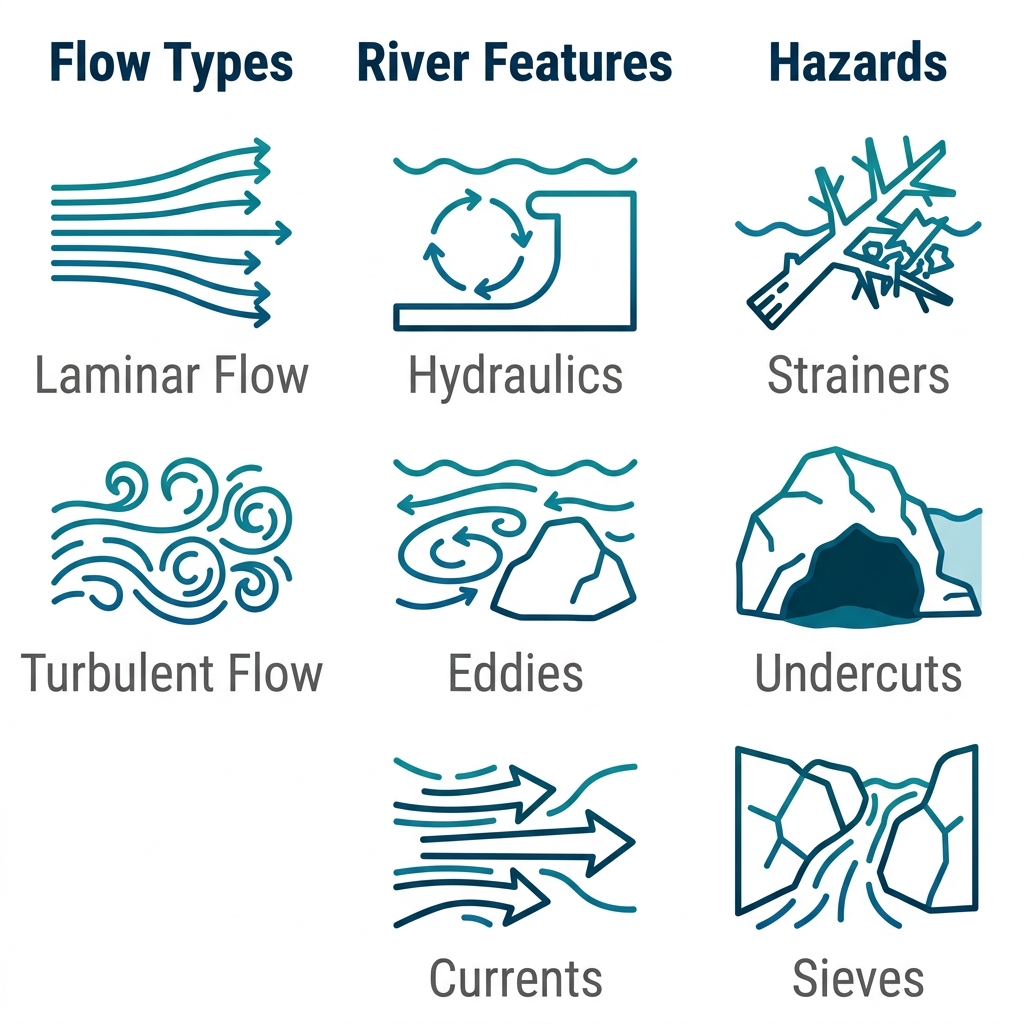 Identify river features, flow types and hazards for safer navigation with this visual icon guide.
With hazards top of mind, grasping how Colombia’s seasons reshape the rivers is the final piece of the puzzle—one that transforms a casual outing into a truly well-prepared expedition.
Seasonal Variability on Colombian Rivers
The Río Samana and its tributaries follow a distinct seasonal rhythm. During the dry season (roughly December to March and July to August), reduced volume exposes intricate rock gardens and demands precise technical navigation. In the rainy months (April to November), higher flows swell the volume and power, creating larger hydraulics and pushing current through constrictions with force. Flash floods are a real hazard after intense downpours in the high Andean watersheds, so we constantly monitor local forecasts and scout ahead before running unfamiliar lines. This is when a solid grasp of swiftwater hydrology becomes indispensable—our guides adapt daily to shifting water levels, always choosing the safest possible route. When sunlight breaks over rain-fed rapids, there’s no better moment to revive yourself in nature, knowing your adventure is backed by planning that only true experts can provide.
Key Benefits of Understanding Swiftwater Hydrology for River Safety
Swiftwater hydrology is the study of how water moves through rivers—currents, eddies, hydraulics, strainers, undercut rocks and recirculating features. When our guides internalize these river dynamics, they can predict where a swimmer or boat will travel in an emergency. That ability is the foundation of every safe expedition we run on the Río Verde, Río Calderas and rivers across Antioquia. Mastering swiftwater hydrology turns reactive moments into practiced, calm responses.
Enhancing Rescue Strategies with Hydrological Knowledge
Reading the river translates directly into better rescue planning. Before we launch any raft or kayak, our team identifies upstream eddies for boat access, positions safety throw bags below key rapids, and pinpoints pinch points and strainer hazards that could trap a paddler. Choosing the right entry and exit points along the riverbank comes from understanding how current seams, eddy lines and recirculating flows shape the channel.
That same hydrological awareness shapes our work with technical rope systems. Knowing how water velocity pulls on a line tells us when to set anchored crossings, tensioned diagonals or highline systems, and it helps us anticipate how rope angles shift under load. In rescue scenarios, we rely on this knowledge to move quickly without adding unnecessary risk.
Of course, adventure activities carry inherent risks; participants must follow guide instructions and safety briefings throughout every expedition. Even with advanced training we stay humble—and that respect keeps everyone safer.
Professional Guide Certification and Skill Development
Hydrology isn’t just a field skill—it’s the backbone of professional development. Swiftwater rescue certification programs we complete devote significant training blocks to river dynamics, and earning a credential means demonstrating you can apply that understanding under pressure. Our guides carry swiftwater rescue certification in Colombia and beyond, and that certification opens career pathways well beyond an entry-level season.
Guides with strong hydrology knowledge are better positioned for advanced qualifications, including multi-day rafting expeditions like our Río Verde 2-day trip and the ability to teach kayak classes or rescue courses with real credibility. When you train with us, you’re building a skill set that grows with you—from reading a rapid to leading expert-level descents.
Building Confidence and Safety for Adventure Tours
Hydrology-trained guides don’t just run safer trips; they create a completely different guest experience. When water levels shift after rain, our guides adapt quickly—selecting lines that suit the day’s flow and keeping the ride fun without surprises. Pre-trip briefings connect river science to the adventure ahead, reducing anxiety and building genuine trust before guests even touch the water.
That preparation is why we say the experience is built “By the experts.” Guests leave with more than stories of big rapids—they walk away with a sense of “Great adventure, food, fun and memories” and the feeling they truly connected with nature. When you raft or kayak with Freak’n Creek’n, you’re not just riding a river; you’re learning from people who see its every nuance. Come “Explore yourself with nature” and see the difference that deep hydrological knowledge makes on every trip.
How Swiftwater Hydrology Works on Colombia’s Rivers
Swiftwater hydrology is the study of how water moves through river channels, blending physics, geology, and fluid dynamics. Here at Freak’n Creek’n, our guides use swiftwater hydrology to read every rapid on Colombia’s rivers, and in this section we break down the mechanics, the role of the riverbed, and how that knowledge comes alive on the trips we run in Antioquia.
Mechanics of River Currents and Water Flow
Everything starts with the gradient: the steeper the riverbed, the more gravitational potential energy converts into water speed. High-gradient Andean streams in Antioquia race downslope far faster than a lowland meander, and even a short stretch on the Santo Domingo creek shows how a few extra degrees of slope can turn a quiet glide into a frothy chute. Because of friction with bedrock and gravel, water moves fastest at the surface and slowest along the bed, creating a velocity profile we feel when we ferry across current. Shear stress — the force the current exerts on the bed — is what carves pools, scours channels, and rearranges everything from fine sand to truck-sized boulders during a rainy-season flood.
The Role of Grains and Obstacles in Shaping Rapids
The riverbed itself wears the tools of its own sculpture. Bedload — gravel, sand, cobbles — and suspended sediment act like natural abrasives that grind the channel deeper and wider; during the rainy season, higher discharge moves larger grains and can completely reorder a rapid between one visit and the next. When the current hits a boulder, it piles up into a pillow upstream, curls around to form a quiet eddy on the downstream side, and pours over a ledge or rock to create a recirculating hydraulic or hole. Channel constrictions squeeze the flow into tall, glassy standing waves. Understanding swiftwater hydrology means recognizing how these features work. Antioquia’s granitic bedrock — part of the Antioquia batholith — and the house-sized volcanic boulders that litter the beds of the Río Samana, Río Verde, and Santo Domingo creek create the boulder-garden character that makes our runs so distinctive.
Practical Examples from Río Samana and Río Verde
On the Río Verde 2-day, the river drops through a pool-drop staircase in the foothills, offering slides, ledges, and waterfalls that demand we read the approach eddy, the lip, and the recovery zone. The Río Samana carries higher volume; here our focus shifts to lateral waves and strong eddy lines as we ferry across the current to set up for the next drop. The Santo Domingo creek is the steepest member of the family — a boulder-choked, continuous class IV–V run full of pinches and pourover holes where we scout the line, regroup in micro-eddies, and thread between house-sized obstacles. Behind every line we choose is a read of the hydraulics, and that read is backed by swiftwater rescue certification and the ability to deploy technical rope systems when a pinned boat or a swimmer needs recovery. Knowledge like this is never just theory — it’s what turns moving water into a safe, unforgettable adventure. Every trip becomes a lesson in how a river lives, and that’s the experience we share with our guests, by the experts.
Best Practices for Applying Swiftwater Hydrology in River Trips
Swiftwater hydrology studies current speed, gradient, depth, and submerged features that create eddies, holes, and hydraulics. Our guides apply swiftwater hydrology on every trip—from the Río Verde to the Santo Domingo—to read the river and choose the safest line. That process begins long before anyone gets wet.
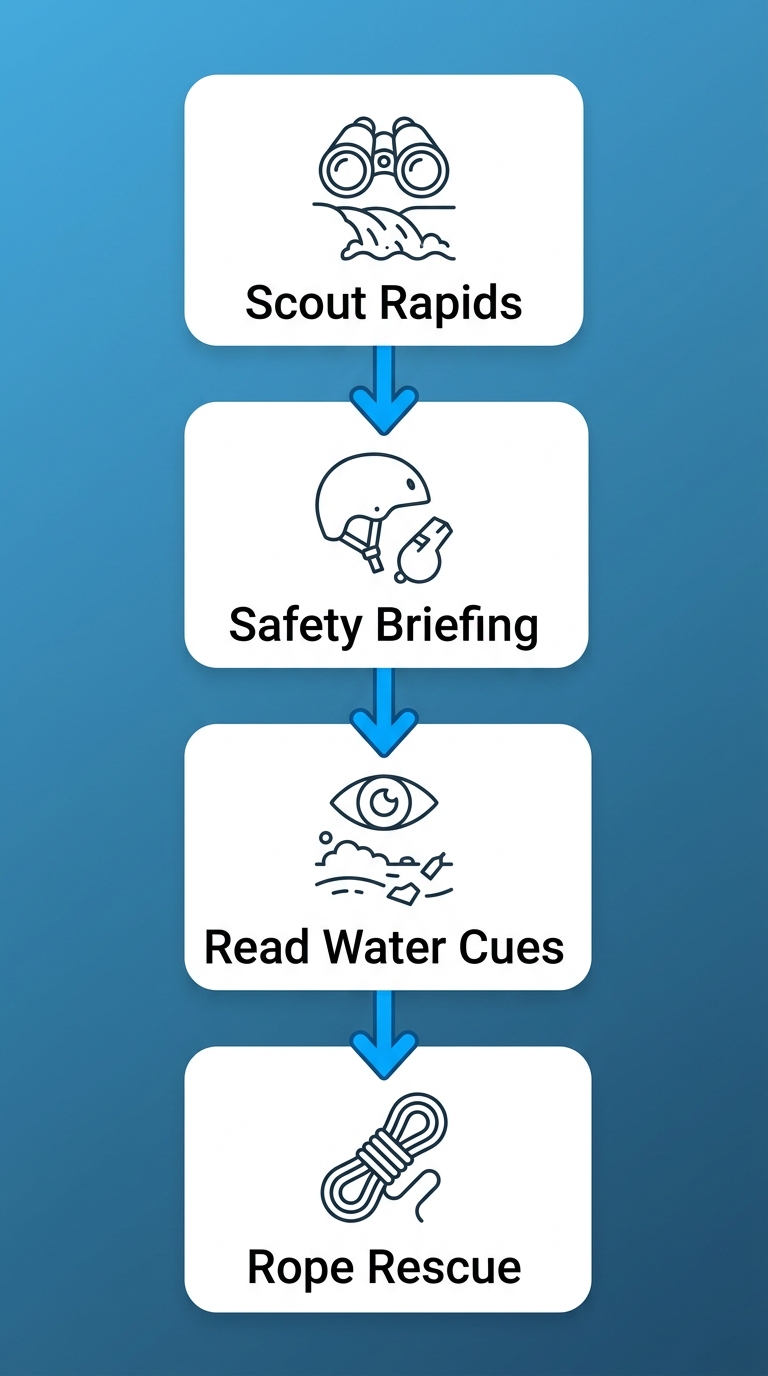 Four-stage river safety flow from scouting rapids to rope rescue.
Putting hydrology to work on the river, we follow a four-stage safety flow.
Pre-Trip River Assessment and Safety Briefings
Before launching on the Río Samana or the Melcocho, our guides scout the rapid from the bank or a vantage point. They check current water levels against recent rainfall reports and scan for strainers, undercut rocks, sieves, and pinning hazards that swiftwater hydrology teaches us to anticipate. Then they share the key risks with guests through a clear, hands-on safety briefing. We use simple hand signals, explain raft spacing, and walk through what to do if someone pops out of a raft. Because adventure activities carry inherent risks, participants must follow guide instructions and safety briefings at all times. This routine turns hydrological knowledge into a practical plan every guest understands.
Real-Time Decision Making with Hydrology Indicators
On a technical run like the Santo Domingo, our guides apply swiftwater hydrology to adapt the line moment by moment. They watch for:
- Foam lines that mark current-eddy boundaries.
- Debris movement revealing surface flow direction.
- Eddy size and shape indicating current strength.
- Wave train patterns signaling submerged obstacles.
- Boils and pillows on rocks that warn of upwelling currents. A foam line shift may mean the main current has moved, so we adjust the ferry angle. A large eddy lets the group rest; a small eddy requires a fast, precise entry. By matching these surface indicators with our understanding of flow behavior, our guides choose the line that balances excitement and control.
Integrating Technical Rope Systems and Rescue Techniques
When hydrology reveals a strainer downstream, our rescue approach combines technical rope systems with river reading. We build a 3:1 or 5:1 Z-drag with pulleys and prusik hitches, anchor upstream of the incident, and control vector angles to avoid creating new hazards. The current’s speed and direction tell us where to place the anchor and how to angle the rope so the rescue team stays out of the main flow. By integrating hydrology with rope rescue training, we react swiftly while protecting both the victim and the rescuers.
Continuous Learning and Certification Pathways
From first-aid refreshers to swiftwater rescue recertification, continuous learning drives every trip we lead. Earning a swiftwater rescue certification deepens a guide’s ability to read moving water and apply technical rope systems under pressure. At our Cocorná basecamp, we run skill clinics, raft guide school, and youth programs that keep our team sharp. With more than 30 years of combined experience, we bring Swiftwater Rescue, Wilderness First Aid, and USCG-approved equipment to every river. That commitment helps you explore yourself with nature, enjoy great adventure, food, fun and memories, and revive yourself in nature—by the experts. There’s no better way to experience Colombia’s rivers. Book a guided trip or a training clinic to put hydrology into practice.
Your Path to Mastery in Swiftwater Hydrology and Adventure
True river mastery begins when you look beyond the surface and start reading the story the water is telling you. At its heart, swiftwater hydrology is the study of how moving water behaves—its currents, eddies, hydraulics, and hidden strainers. Every paddler, whether taking a first stroke or chasing technical creeks, gains confidence and safety by understanding these moving water dynamics. When you pair that knowledge with hands-on practice on a real river like the Santo Domingo creek near our basecamp in Cocorná, Antioquia, the river transforms into both your classroom and your greatest teacher.
Explore yourself with nature as you build skills in a progression that honors where you are today. Begin with river reading and basic paddling, advance through kayak classes and skill clinics, and then deepen your expertise with a swiftwater rescue certification—a natural milestone for those committed to safety and leadership on the water. As your journey unfolds, our river rescue and technical rope rescue courses introduce technical rope systems as a core discipline, strengthening your ability to solve complex challenges in the river canyon. This pathway blends theory, muscle memory, and Great adventure, food, fun and memories into real competence.
Ready to take the next step on the river? Join us on guided rafting trips, creeking descents, or multi-day expeditions across Colombia, where every current reinforces the skills you’re developing. Led by the experts, every outing is an invitation to Revive yourself in nature, apply emerging abilities in wild settings, and keep growing with each river bend you navigate.